|
|
Now
that we know a few of the basic
shapes of folds in fabric, let's
move on and see how clothing
should look when it is actually
being worn by someone. At the
left, we have an example of a
very loose, draping sleeve. As
mentioned before, the main thing
to consider is which direction
the fabric will be pulled. The
sleeve here is being pulled in
two main directions: downwards
because its pulled by gravity,
and to the left because its
attached to the main garment and
is being stretched across the arm
and torso. The folds in the
sleeve will follow the direction
that the cloth is being pulled.
Notice also how the cloth bunches
up around the wrist. This isn't
necessary, but it does indicate
the length and looseness of the
sleeve.
|
|
Here
are three more sleeve examples.
These sleeves are not as loose as
the one shown above, and all
stick pretty close to the arm. In
these examples, the cloth is
stretched from the arm to the
shoulder and torso, rather than
being pulled down mainly by
gravity. There isn't enough
material to be pulled down too
greatly. Since the fabric is
pulled horizontally, the folds
should reflect this. The best
example is the top picture here;
notice how the folds move towards
the shoulder instead of towards
the ground. The sleeve in the
middle picture is a little
looser, and is pulled down by
gravity more. The sleeve in
bottom picture is big and loose,
but is rolled up at the elbows,
and thus doesn't hang and droop
as much as the sleeve in the
previous example.
|
|

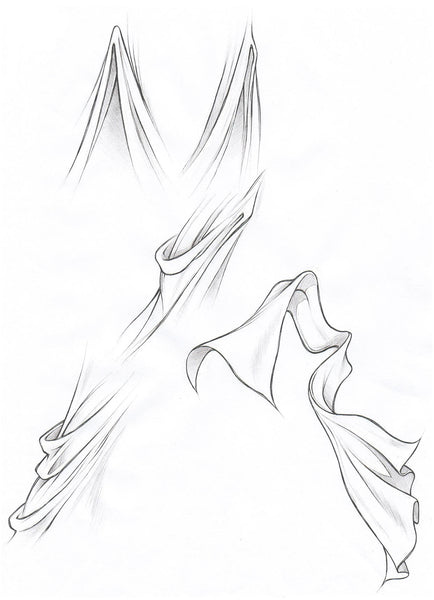
These are some
miscellaneous bits of clothing
that didn't fit into any of the
other sections of this tutorial,
but that I wanted to include
anyway. In all these examples,
try to identify where the cloth
is being pulled towards and in
what direction (for example, is
it being pulled roughly towards
the shoulder, or draping loosely
over the subject?). Always
remember to shade wherever the
light doesn't fall, such as
grooves, areas inside the folds,
and places where the cloth
overlaps.
|
|

One small but
important thing I would also like
to go over before continuing is
the effect that stripes can have.
If you are drawing clothing that
has stripes or a pattern on it,
make sure that the pattern moves
along with the rest of the
fabric. Where the cloth bends,
the stripes and patterns will
bend, as well. This can be
difficult to draw and shade,
especially when you are dealing
with complex patterns, but it can
add a really nice three
dimensional look to your
picture.
|
On
to the Next Section!
RETURN
TO MAIN
|